.svg)

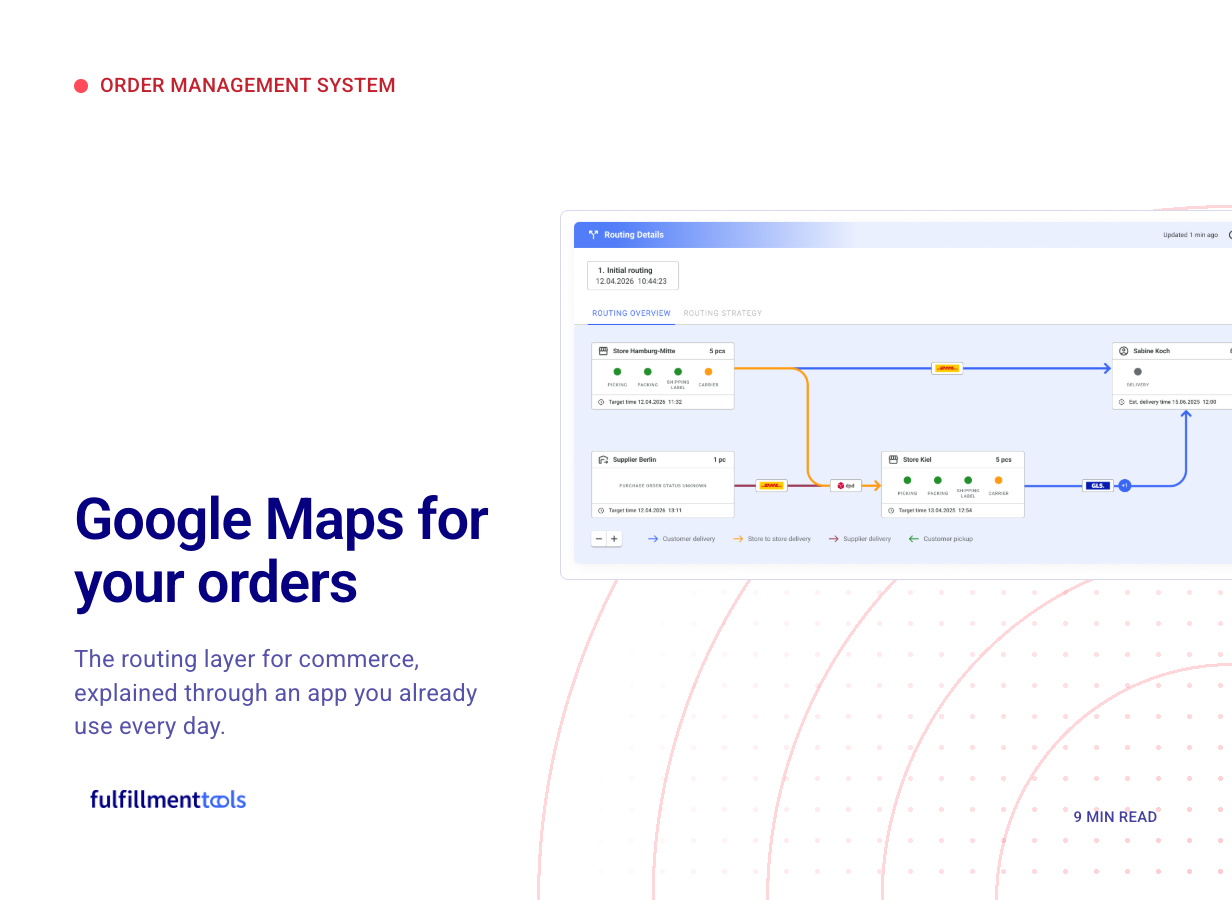
Google Maps for your orders: Order management, explained

Key Takeaways
- An order management system is the routing layer for physical commerce. It keeps an honest map of what inventory exists and where it sits, decides which location should serve each incoming order, and watches the orders that go off course.
- Routing is a trade-off, not a fixed rule. Cheapest, fastest, and best for inventory health are three different answers to the same order. Which one is correct depends on a business goal that shifts by season, by category, and by business model.
- An order is a decision that gets revisited, not a record that gets filed. Stores miss pick windows, items turn out to be damaged, carriers miss pickups, customers change their minds. A system that decides once at checkout has no answer for any of it.
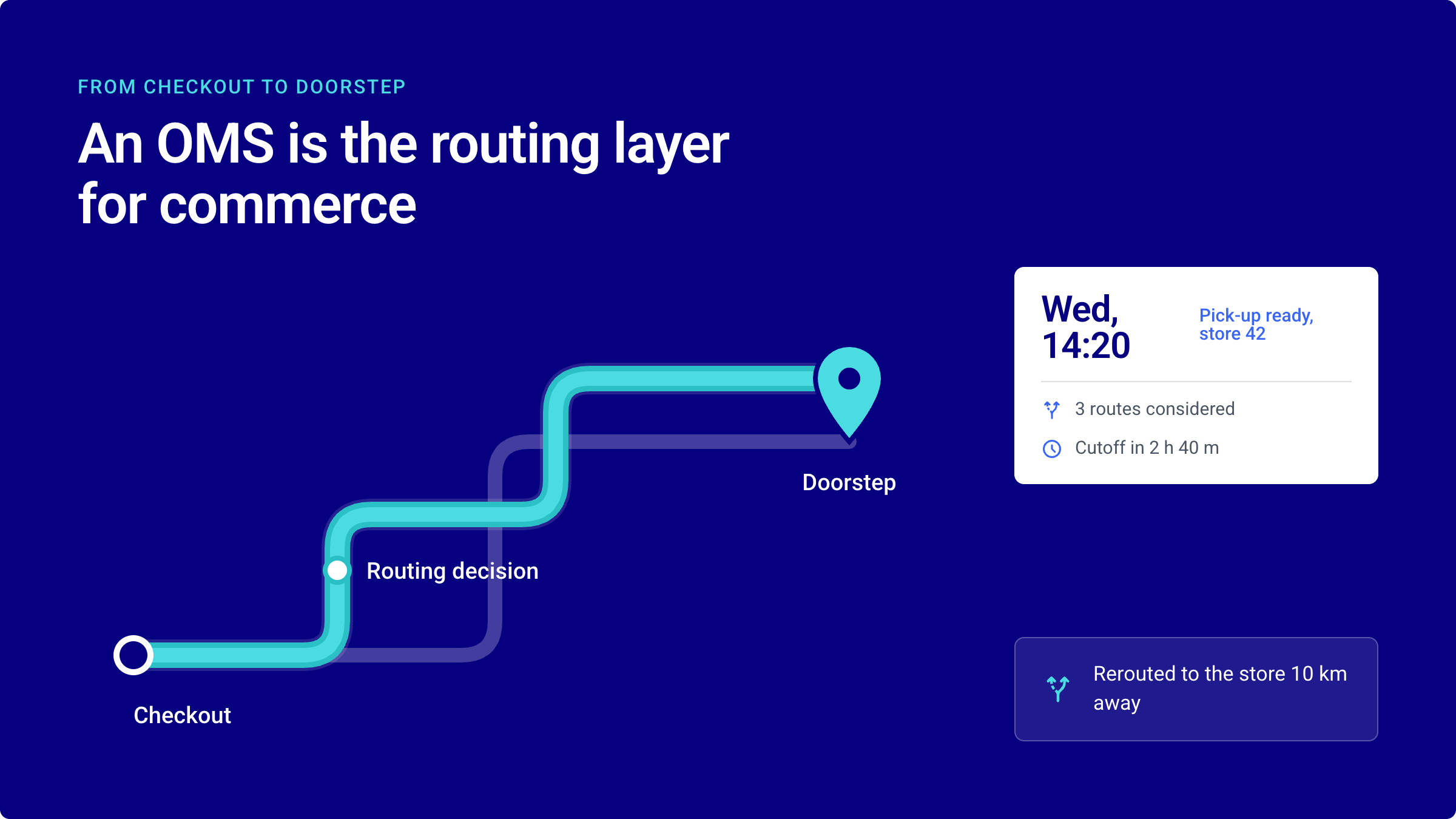
An order management system is the routing layer for physical commerce. It keeps an honest map of what inventory you have and where it sits, decides which of your locations should serve each incoming order against goals you set, watches the orders that go off course, and hands simple instructions to the people doing the picking. It owns none of the warehouses, stores, vans, or systems it directs.
The clearest way to understand it is Google Maps. The comparison holds much further than you would expect, and the places where it breaks are exactly where the hard problems live, whether you are an enterprise retailer with four hundred stores, a brand shipping direct to consumer from two facilities and a partner warehouse, or a 3PL running fulfillment for a dozen clients at once.
Google Maps and order management, side by side
Why can nobody explain this category?
Try explaining an order management system at a dinner party. Start with order management system (OMS) defining the category, move on to available-to-promise, mention ship-from-store, and watch people reach for their drinks. The category does not help itself. Its core function is usually called orchestration, a word that means something slightly different to everyone who says it.
For me navigation is a better frame, because everybody already understands it. You have a starting point, a destination, a network in between, and a set of trade-offs about which way to go.
Does an OMS replace your ERP or your warehouse system?
No, and that is the point. Google Maps laid no asphalt. It owns no cars, employs no drivers, and controls not a single traffic light.
What it owns is the map, the live picture of what is happening on it, and the logic that turns both into a recommendation.
An order management system sits in the same position. It owns no warehouse, no store, no van, no ERP, and no e-commerce platform. It reads what those systems know, applies logic, and tells them what to do next. That is the whole reason the composable, API-first approach matters: an OMS is a decision layer over infrastructure someone else already paid for. fulfillmenttools was built this way from the start, which is why it goes into a landscape of existing systems rather than asking an enterprise to rebuild one.
Why does an OMS need a single view of inventory?
Because Maps is only as good as its map. A road that closed last month but still shows as open will send you into a dead end with complete confidence.
The equivalent here is the inventory view, and it is the single most common failure point. A customer buys the last blue jacket in a size 38. The system thinks it is in store 42. In reality it is on a mannequin in the window, sun-bleached down one side, and nobody updated anything. Or worse, two customers buy it within the same minute from two different channels, because neither channel knew about the other. A 3PL has the same problem in a different shape: one client's units sitting on a shelf next to another client's, and a commitment made against the wrong pool.
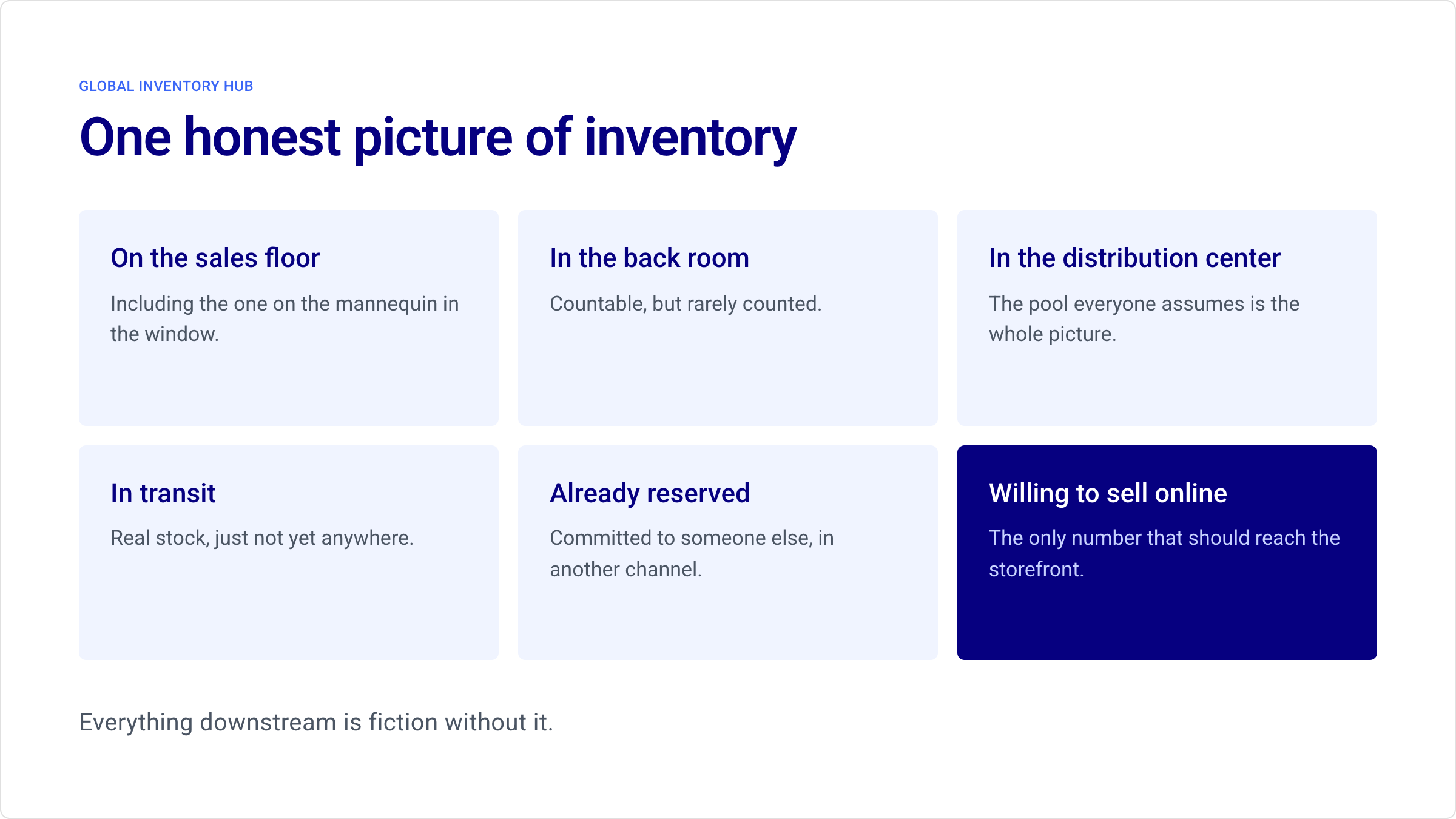
Before any clever routing happens, an OMS has to maintain one honest picture of inventory: what is on the sales floor, in the back room, in the distribution center, in transit, already reserved for someone else, and how much of it the business is actually willing to sell online. Everything downstream is fiction without it.
How does order routing decide where an order ships from?
The same way Maps decides on a route, which is to say: it depends on what you asked for. Maps does not give you one answer. It gives you a fastest route, a shorter route that takes longer, and an option that avoids highways. Same start, same destination, different answers depending on what you care about.
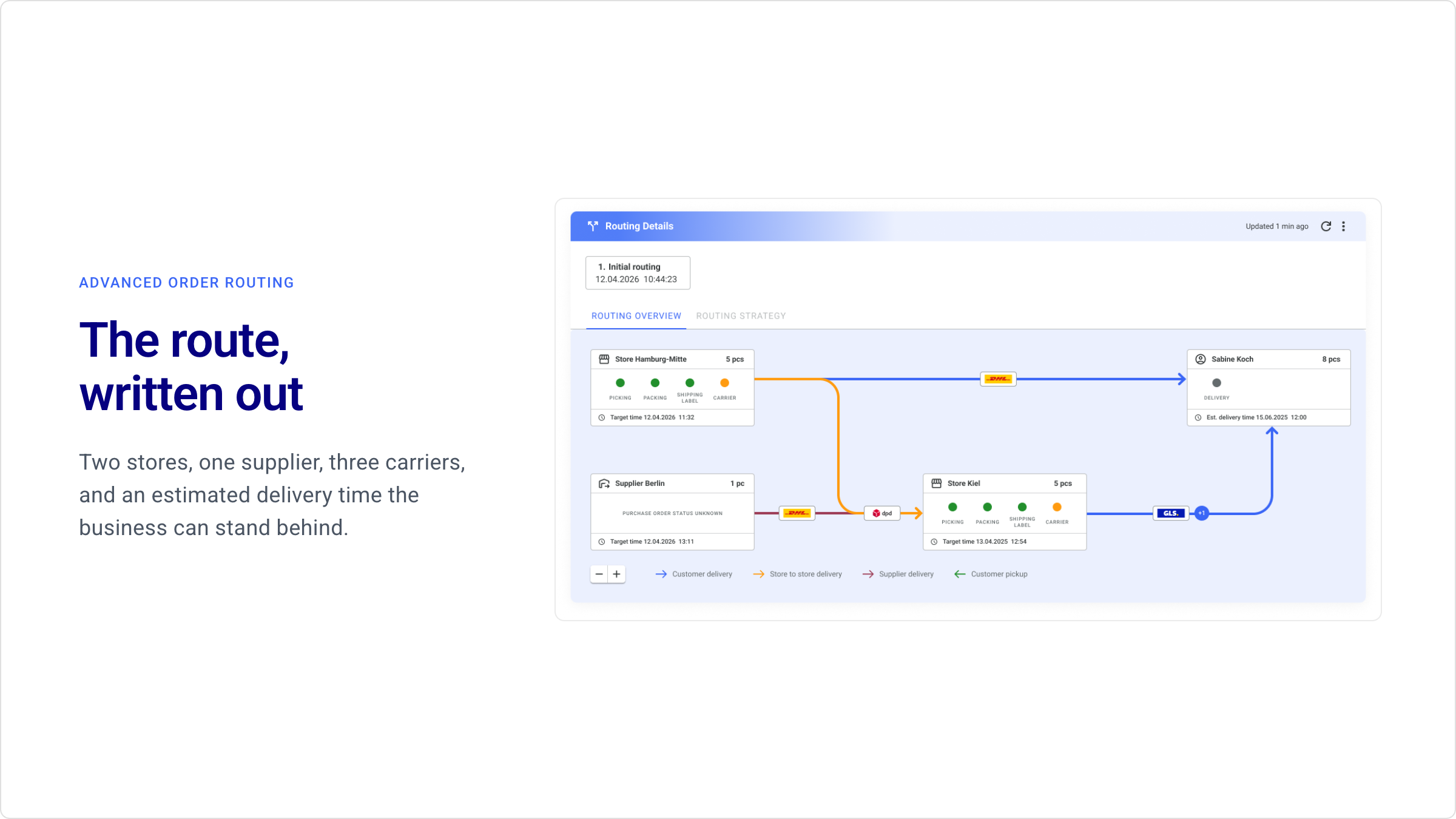
Advanced Order Routing works identically. One order, one delivery address, and a set of legitimate answers:
- Ship everything from the central distribution center, because that is cheapest per parcel and keeps store staff free.
- Ship from the store ten kilometers away, because the customer gets it tomorrow instead of Thursday.
- Split the order across two locations, because that is the fastest way to get all three items moving, and absorb the second parcel cost.
- Send it from the store sitting on last season's inventory, because clearing that inventory is worth more this month than saving on shipping.
None of these is correct in the abstract. They are correct relative to a business goal, and that goal changes by season, by category, by margin, and sometimes by week. The objective set also changes by business model. A brand weighs direct-to-consumer margin against the wholesale and marketplace channels drawing on the same units. A 3PL weighs cost to serve against a contractual service level that is different for every client in the building, and has to be able to prove afterward which one it honored. The Order Routing Agent in fulfillmenttools exists to make that decision per order, against the rules the business has set, rather than defaulting to whatever the warehouse did last year.
What happens when a store is already slammed?
Maps knows about traffic. It will route you around a jam even if that means a longer road, because the shortest path is not the fastest path at five thirty.
Fulfillment has rush hour too. A store on a Saturday afternoon has three people on the floor and a line at the register. Sending it forty pick-and-pack jobs is technically possible and practically a disaster: the orders sit unpicked, the arrival dates slip, and the staff learn to resent the whole program.
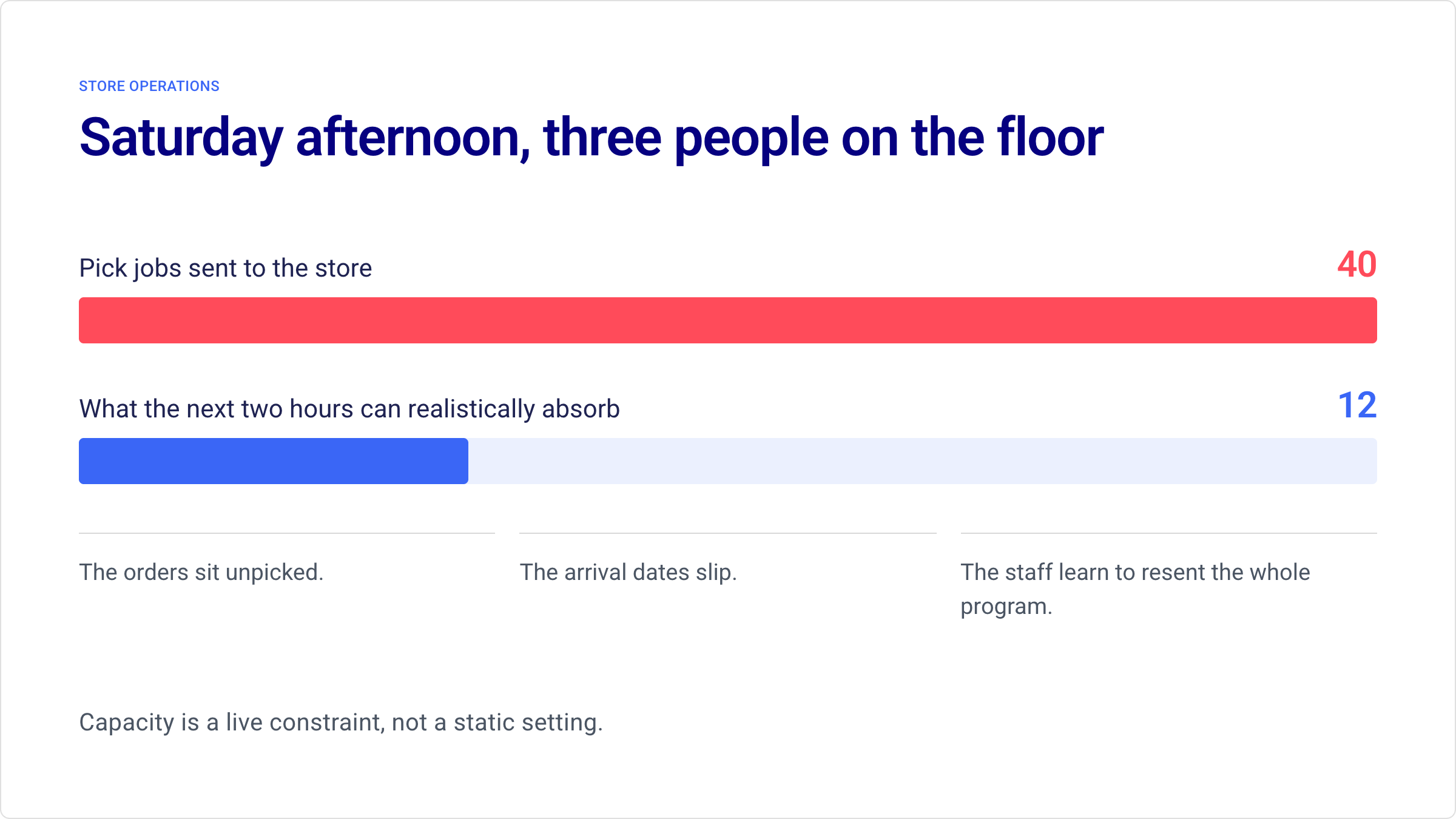
An OMS has to understand capacity as a live constraint, not a static setting. How many orders can this location realistically handle in the next two hours, given operating hours, staffing, and what it has already been given today.
And this is where the real world is harder than navigation. Maps optimizes for you, one traveler at a time. If it sent every single driver down the fastest road, that road would stop being fast. An order management system has to make thousands of these decisions in the same network at the same time, where each decision consumes capacity that the next one wanted. Routing a single order well is arithmetic. Routing a whole day's orders well is balancing.
The arrival estimate is the feature people actually care about
Nobody opens Maps for the polyline. They open it for the number in the corner telling them when they will get there.
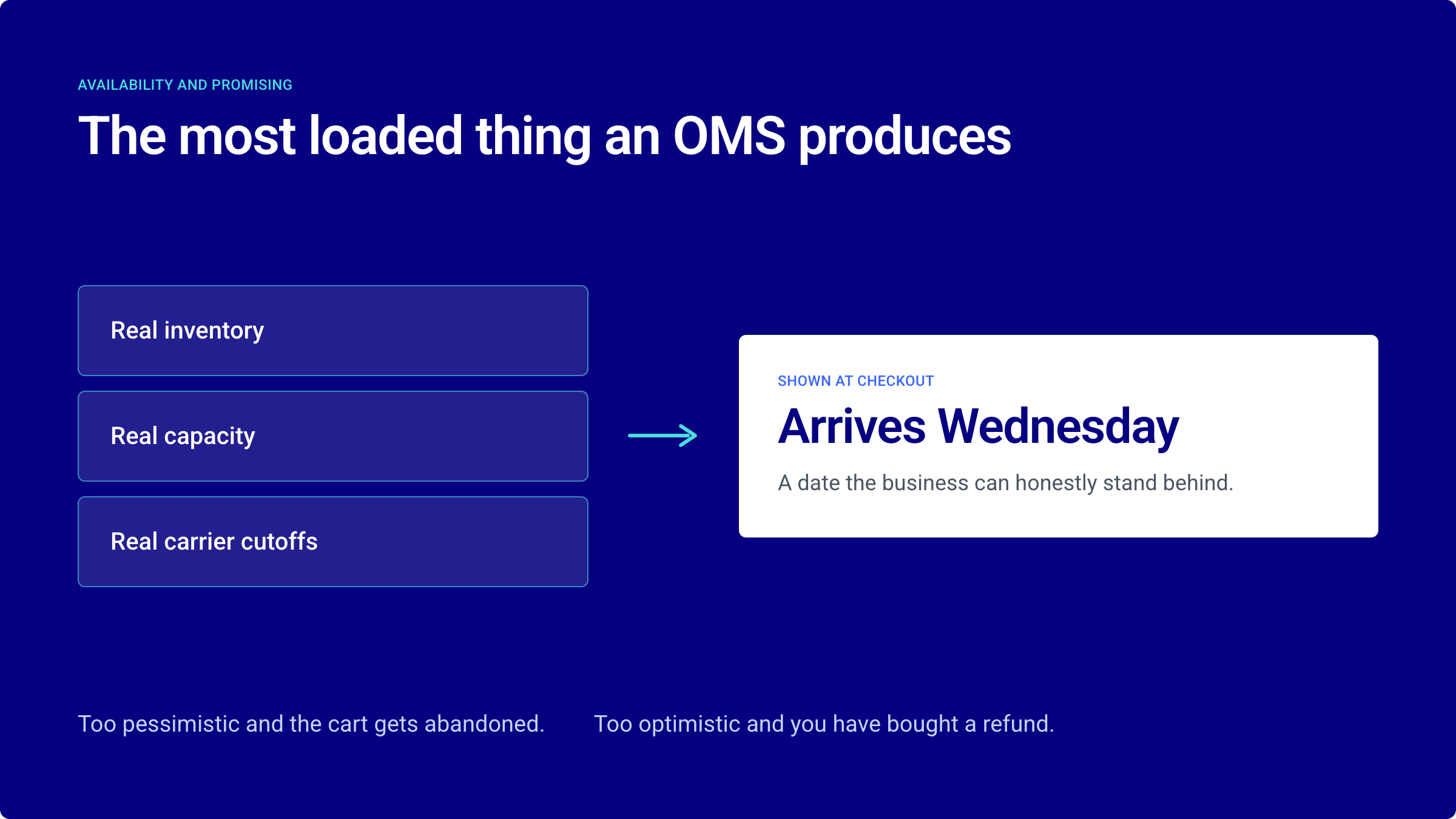
The commercial equivalent is the date shown at checkout, and it is the most loaded thing an OMS produces. Too pessimistic and the cart gets abandoned. Too optimistic and you have bought a refund, a support ticket, and a customer who will not come back. The industry term for the check behind it is Available-to-promise (ATP), and what it really means is: given real inventory, real capacity, and real carrier cutoffs, what date can we honestly stand behind.
Traffic ahead: rerouting an order that is already moving
Maps does not stop working once you pull away. It watches, and when something changes it recalculates and tells you.
Most systems still treat an order as a decision made once, at checkout, and then a record to be filed. But orders drift off course constantly. The store accepts a pick job and does not start it. The item turns out to be damaged when someone actually holds it. The carrier misses the pickup slot. A facility goes down for a day. The customer moves between ordering and delivery.
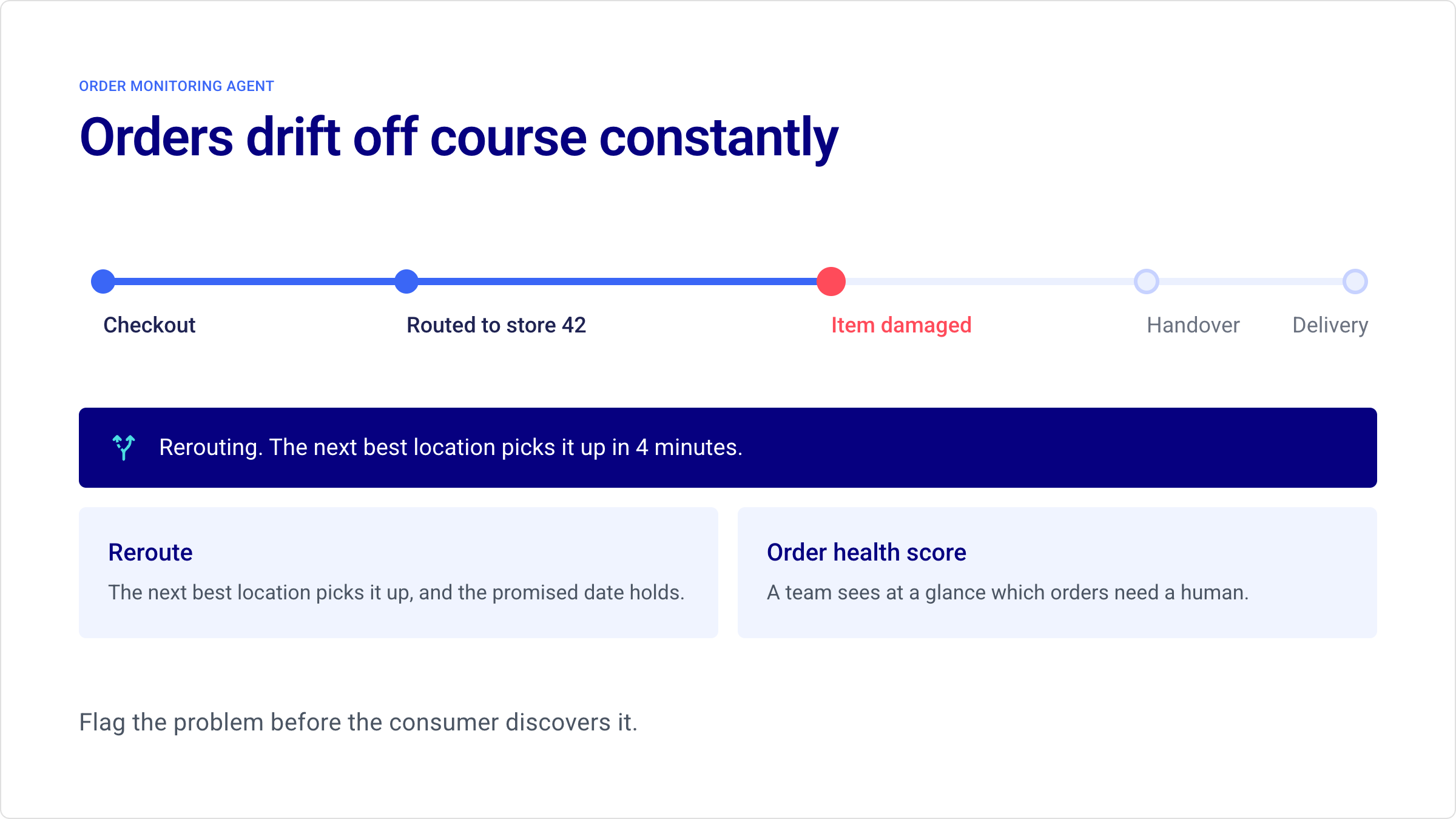
This is the job of the Order Monitoring Agent, which watches orders in flight and surfaces the ones going wrong, expressed as an order health score so a team can see at a glance which orders need a human. Think of it as your client advocate inside the system: it is looking at the order from the customer's side, and its bias is toward flagging the problem before the customer discovers it. Maps telling you that you will now arrive twelve minutes late is annoying. Maps telling you nothing until you miss the flight is unforgivable, and that is how a lot of order data behaves today.
Turn by turn for the person doing the driving
Maps gives a driver one instruction at a time. Turn right in two hundred meters. It does not explain the traffic model, and the driver does not need it.
A store associate or a warehouse picker needs exactly the same instructions. Not a dashboard, not a rules engine, just: these six items, in this order, in this aisle sequence, into this box, with this label, handed to this carrier by this time. The network decides, the store executes. Store staff are not fulfillment specialists and should not have to become them, which is why the interface they touch has to be as precise as a navigation prompt.
Can you change an order after it has been placed?
You can add a stop halfway through a journey in Maps without starting again, and orders need the same thing.
The customer wants to switch from click and collect to home delivery. They want to add an item, change the address, or collect from a different store than the one they chose. And then there is the return, which is the trip home: often to a different location than the one that shipped it, and a decision in its own right about where that item should live next and whether it can be resold from there.
Why you would not want a chatbot choosing your route
Maps does not guess. Its routing is deterministic math over a graph, and that is precisely what you want. You would not accept a route that was creatively improvised each time you asked.
The same discipline applies to order management, and it is worth being blunt about it, because the market is currently full of the opposite claim. Deciding which of four hundred locations should fulfill an order against cost, capacity, and carrier cutoffs is a solved kind of problem, and it should be solved deterministically, repeatably, and fast enough to run at checkout.
Where language models genuinely add value is the layer above: the messy, low-volume, high-context work. Explaining in plain language why an order went to Hamburg and not Berlin. Working through an exception nobody wrote a rule for. Sketching a routing strategy for a peak week and showing what it would have done to last year's orders. That is the AI Sidekick, and the word sidekick is doing real work there. A sidekick is not the one who makes the call. It advises, a person decides. The design principle behind the whole platform is agentic where it adds value, deterministic where it does not.
For anyone keeping count, the lineup is small on purpose: the AI Sidekick advises, the Order Routing Agent decides where an order should go, and the Order Monitoring Agent watches what happens next.
Where does the map metaphor break down?
In four places, and any analogy you cannot puncture is being oversold.
Maps has one objective, essentially time, with a couple of switches around it. A fulfillment network has several objectives in permanent conflict: cost per order, speed to customer, margin protection, inventory health, carbon, and the workload of people who did not sign up to be pickers. Routing is the act of trading these against each other, and reasonable businesses weight them differently.
A wrong turn costs a driver five minutes. A wrong routing decision costs a parcel, a return, a refund, a support conversation, and sometimes the customer relationship. For a 3PL it can cost a service level credit. Recommendations here trigger physical work and real money the moment they are accepted.
Road networks are broadly stable. A fulfillment network is not. Stores open and close, a seasonal facility appears in October, a carrier contract changes in January, a promotion redraws demand overnight, a 3PL onboards a new client with its own packaging rules. Configuration is never finished, which is an argument for a system a business team can adjust without a project.
And Maps has one map for everyone. A retailer with four hundred stores, a brand with two facilities and a partner warehouse, and a 3PL running shared space for a dozen clients are three different networks with three different sets of priorities. The routing logic has to be theirs, not a template.
The part where it disappears
Most Google Maps usage is not in the Google Maps app. It is inside a ride-hailing app, a food delivery app, a car dashboard, a store's contact page. The map became infrastructure that other software calls.
An order management system ends up in the same place. Its value shows up in the e-commerce platform, the customer service desk, the store app, the ERP, and increasingly in tooling that other people's software agents drive directly, which is what onX and the fulfillmenttools MCP Server are for. Choose your interface.
Enterprises rarely lack the assets. They have the facilities, the inventory, and the staff. What they are missing is the map and the routing.
FAQs
What is an order management system in simple terms?
It is the system that decides how a customer order gets fulfilled. It holds one view of all your inventory, chooses which location should serve each order, tracks that order until it arrives, and tells store and warehouse staff what to do. Google Maps for orders is a fair shorthand: it does not own the network, it navigates it.
What is the difference between an OMS and an ERP?
An ERP is a system of record. An OMS is a system of decision. The ERP holds finance, procurement, master data, and the official version of what happened. The OMS decides, order by order, what should happen next across your network, and then tells the other systems. They run alongside each other.
What does distributed order management mean?
It means fulfilling from many locations instead of one. A traditional setup ships everything from a central warehouse. Distributed order management treats stores, distribution centers, partner warehouses, and drop-ship suppliers as one pool of supply, and picks between them per order. This is the capability that makes ship-from-store and click and collect possible at scale.
What is available to promise?
It is the check that produces the delivery date shown at checkout. It asks what can actually be committed to this customer, given real inventory, real capacity at each location, and real carrier cutoff times. A date that comes from an availability check is one you can stand behind. A date that comes from a static shipping table is a guess.
What makes an order management system agentic?
An Agentic OMS keeps deciding after checkout. A rules-based system makes one routing decision per order and moves on. An Agentic OMS monitors what happens next and adapts when conditions change. In fulfillmenttools the lineup is deliberately small: the AI Sidekick advises people, the Order Routing Agent decides where an order should go, and the Order Monitoring Agent watches orders in flight and flags the ones going wrong.
Do you need an OMS if you fulfill from a single warehouse?
Probably not yet. With one location, one channel, and a simple delivery offer, a commerce platform and a warehouse system can cover it. The case for an OMS appears when there is more than one place an order could come from, more than one channel drawing on the same inventory, or a delivery date you need to get right rather than pad.
Who is an order management system for?
Any business with more than one place an order could be fulfilled from. That is the qualifying condition, and it shows up in three shapes.
Retailers with store networks are the most visible case: hundreds of locations holding sellable inventory that the online channel cannot touch unless something decides between them. Brands face the same problem across fewer locations, typically a distribution center or two plus a partner warehouse, with direct-to-consumer, wholesale, and marketplace channels all drawing on the same units. 3PLs face it across clients rather than channels, with a different service level to honor for each one and the obligation to show afterward which one was met.
Inspired by what you’ve read?
Talk to our team to explore how fulfillmenttools can support your growth.