.svg)

Conquering the furniture industry's toughest challenges with order management


Key Takeaways
- Omnichannel integration is essential in the furniture industry
Furniture retailers must connect stores, warehouses, and drop shippers to create a seamless customer experience. Real-time inventory transparency across all channels is crucial to avoid stock issues, reduce costs, and meet customer expectations. - Complex fulfillment requires intelligent order orchestration
Due to diverse product sizes, delivery methods, and fulfillment sources, furniture logistics are highly complex. A Distributed Order Management System (DOMS) helps optimize order routing, reduce costs, and ensure efficient and timely delivery across different channels and locations. - Enhanced services and transparency improve customer satisfaction
Providing clear delivery information (e.g., availability, split shipments, delivery times) and offering value-added services like scheduled delivery, assembly, or old item removal significantly improves the customer experience and strengthens competitiveness
The furniture industry is a large, complex market with one of the world‘s fastest growing eCommerce sectors. As a result, customers are becoming more demanding and require digital offers and services. Furniture stores therefore face the challenge of meeting customer needs, keeping up with the competition and exploiting the potential that the online boom offers them. Stores remain relevant despite growth in the eCommerce sector but should be linked to other sales channels. This is how retailers are positioning themselves omnichannel with a seamless, service-oriented customer journey.
Create transparency across all channels
The furniture industry handles an extensive and complex range of products. These are products of the most varied scope - from bedside lamps to massive bookshelves. The sizes and product ranges of the individual stores often vary greatly. In addition, warehouses and drop shippers also hold stocks. This is why keeping track of stock in the furniture segment is often a major challenge for retailers. As a result, stocks are not used optimally, overstocks and out-of-stocks occur and customer demand cannot be met. If retailers do not have an overview of which goods are available at which location, this also leads to rising delivery costs due to the provision of products from different sources. By connecting your entire fulfillment network, you can synchronize your stocks in real time with the help of an inventory management.
Enter delivery information during checkout
By creating transparency about your stocks, you can show your customers Fulfillment Options like availability and delivery times at the product detail page and during checkout. With an order management system, you can seamlessly connect different carriers and give your customers the option of selecting the carrier themselves. You can also show your customers split shopping baskets in the checkout and inform them how many packages they can expect and when they will arrive. You can even give your customers the option to choose whether they want to wait for all items to be delivered or whether one item should be delivered faster by splitting the order.
By creating transparency about your stocks, you can show your customers availability and delivery times at the checkout. This enhances customer satisfaction.
Reduce costs through optimized order routing
Trading in products from furniture stores presents several challenges when processing orders. This is mainly due to the variety and size of products from different brands, which requires complex handling. Furniture stores sell many items alongside furniture - from decorations and tableware to lamps - which complicates the fulfillment of customer orders. For example, if a customer‘s order consists of products that vary in size and the required shipping method, this can be challenging in fulfillment. An internationally distributed network also poses challenges, as different countries have different fulfillment requirements. The fulfillment network of furniture stores usually consists not only of their own warehouses and stores, but also includes drop shipping and crossdocking. There are many factors in the furniture industry that make fulfillment complex.
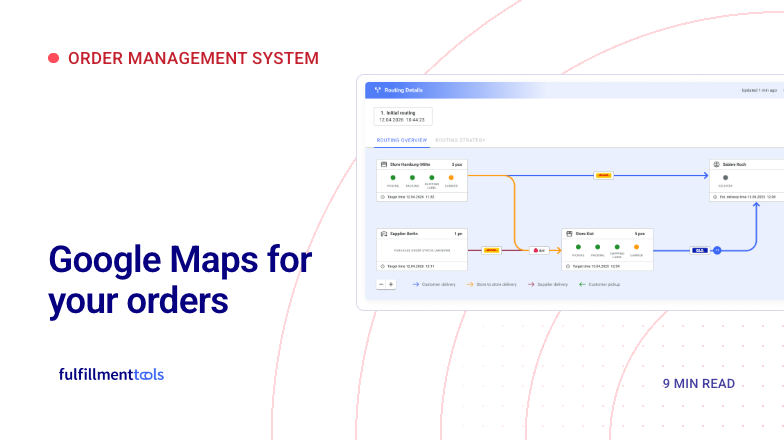
In order to offer customers the same experience online and offline, a technical solution such as a Distributed Order Management System (DOMS) is required. This can help to find the best route and location for the fulfillment of a customer‘s order based on configurable rules, considering the special features and characteristics of the individual products.
Example
If a customer orders a lamp and a cabinet, the lamp is usually sent as a package and labeled as fragile, while two-man handling is required for the cabinet. In addition, the order is split between different sources to ensure complete fulfillment: The lamp is shipped from the warehouse and the cabinet via drop shipper. The challenge is to distribute the order in such a way that the process costs are minimized, the customer receives the products conveniently and the individual components of the order are delivered in quick succession. The distribution of the lamp and the cabinet to different sources in a network requires different routing rules for the shipment of two-man handling and parcel goods. When delivering the cabinet, the distance between the shipping location and the customer address directly influences the price, which is not the case for parcel deliveries. In order to act cost-efficiently, different methods must be used to distribute the two products to the sources of supply.
Offer additional services
A shipment that is sent via a forwarding agent cannot simply be left with the neighbors if customers are not at home. That is why you should offer the option of booking a delivery date on the website or when ordering in-store to accommodate the customer‘s wishes as much as possible. When buying a kitchen, for example, it may be necessary to make an appointment with the customer to measure the space on site. Here, too, you should offer a simple and customer-friendly way to make an appointment. Services such as the assembly of furniture or the removal of old furniture and appliances (e.g. old kitchens) should also be offered to customers as an additional service in order to increase customer satisfaction. An order management system can determine the best way to handle services such as the assembly of a cupboard and coordinate the processing of the service.
With our Distributed Order Management System, you can optimize all these steps in your customer journey, optimize your service portfolio and offer a convenient shopping experience. At the same time, you can simplify your processes and improve the utilization of your resources.
Written by:
Jennifer Wilken-Wetzstein
Marketing Manager
Inspired by what you’ve read?
Talk to our team to explore how fulfillmenttools can support your growth.