Part 4: Why real-time inventory is the foundation every AI agent depends on

Key Takeaways
- AI agents make decisions based on data. If inventory data is stale, those decisions are wrong, no matter how good the agent is.
- Real-time inventory means changes are visible across the network the moment they happen, not minutes later.
- Without real-time inventory, agentic commerce cannot work reliably. With it, automation becomes trustworthy.
The problem with "good enough" inventory
For a long time, inventory accuracy was treated as a back-office concern. As long as the numbers were roughly right by the end of the day, operations could function. A batch update every few hours was acceptable. A small buffer of safety stock covered the gaps.
That approach breaks down the moment decisions get automated.
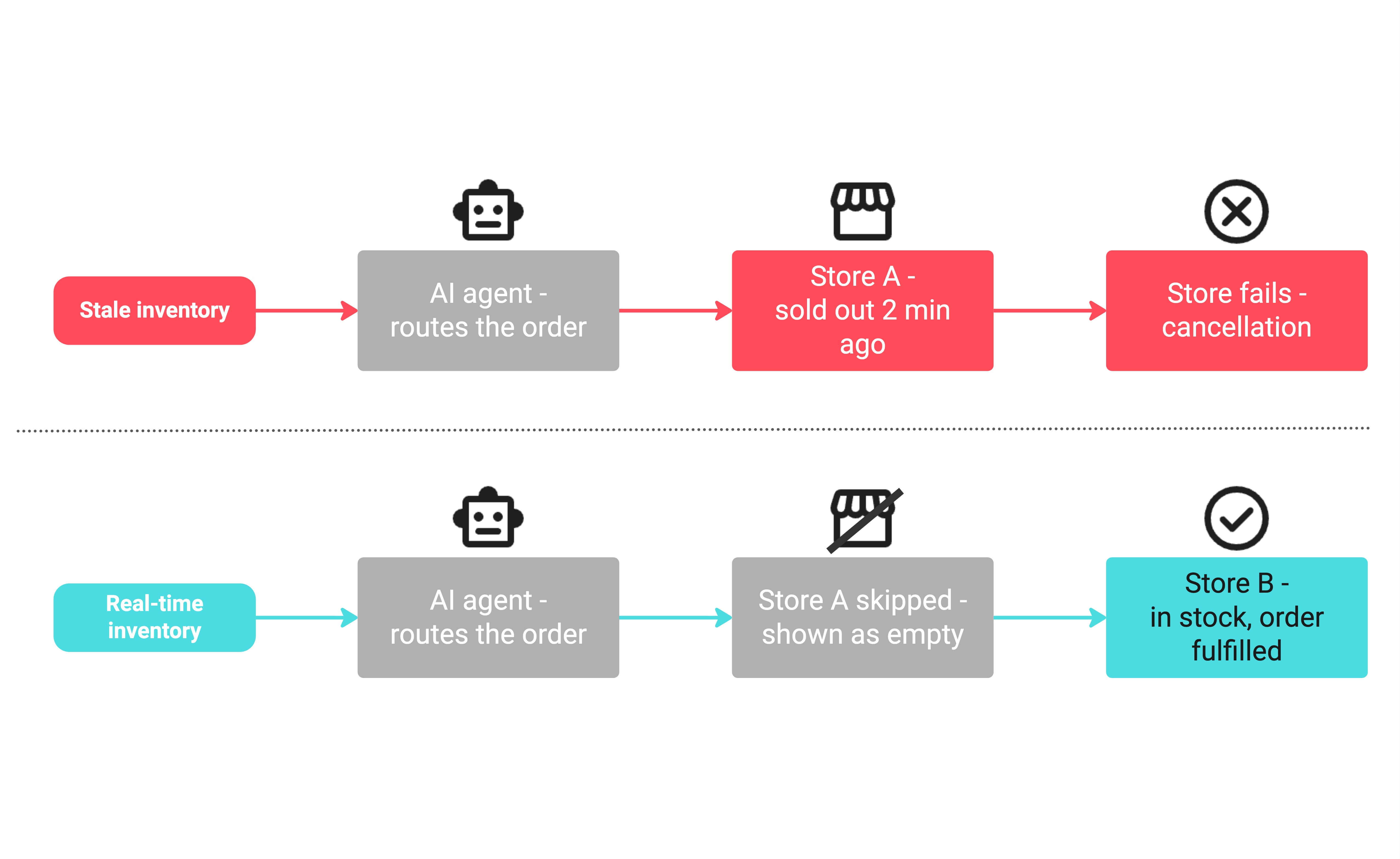
Consider a simple scenario. A customer places an order for a product that your system shows as available in three stores. An AI agent routes the order to the nearest one. But that store sold its last unit two minutes ago, and the system had not synchronized the change yet. The agent made a decision that was technically correct based on the data it had, and operationally wrong based on reality.
When a human handles this, they might catch it. They know that store has been busy, they call to check, they use judgment. When an agent handles it at scale, across thousands of orders, there is no judgment to fall back on. There is only data. And if the data is wrong, the decisions are wrong.
What real-time actually means
Real-time inventory is not the same as frequently updated inventory.
Frequently updated means the system refreshes every few minutes. Better than once a day, but still a window where reality and data diverge. In that window, agents make decisions on information that is already outdated.
Real-time means inventory changes are visible across the entire network the moment they happen. A sale in a store is reflected immediately. A delivery arriving at a warehouse becomes available for fulfillment instantly. A return entering the system updates availability without delay.
The difference matters most precisely when things are moving fast: peak season, flash sales, high-demand products. These are the moments when stale data causes the most damage, and exactly when real-time accuracy matters most.
Why agents depend on it
Here is where it connects back to onX and the broader agent ecosystem.
When an external AI agent connects to your OMS through onX, it queries live data. A customer service agent checks whether an item is in stock before promising a delivery date. A demand forecasting agent factors current availability into its predictions. A marketing agent confirms fulfillment capacity before launching a campaign for a product.
Every one of these agents is only as reliable as the inventory data underneath. onX provides the standardized connection. Real-time inventory provides the trustworthy data that flows through it. One without the other does not work.
This is why we think of real-time inventory as foundational. It is not a feature that sits alongside the agentic capabilities. It is the ground those capabilities stand on.
What it takes to get there
Real-time inventory at enterprise scale is harder than it sounds. It requires a few things working together, and they are the principles behind fulfillmenttools' Global Inventory Hub.
A single source of truth. Inventory data scattered across point-of-sale systems, warehouse management, and the webshop creates conflicting views. The Global Inventory Hub brings these together into one central inventory source, so there is one answer to "what do we have and where."
Event-based updates. Instead of refreshing on a schedule, the system reacts to events as they happen. A sale, a delivery, a return: each triggers an immediate update that flows through the network.
Network-wide visibility. Stores, warehouses, dark stores, and supply chain all need to be part of the same picture. A fulfillment decision is only as good as the completeness of the network view behind it.
What makes the Global Inventory Hub different is the level of control. It does not just aggregate data from across the network. It applies channel-based inventory logic and location-specific rules, so availability is managed consistently across every channel without overselling. That distinction, between aggregating data and actually steering it, is what separates real inventory control from simple visibility.
From reactive to proactive
Real-time accuracy is the foundation. But it is also the starting point for something larger.
As the Global Inventory Hub gathers richer data across sales, purchasing, and locations, the direction is clear: from showing what is happening to recommending what to do about it. Intelligent recommendations for stock levels, allocations, and replenishment. Configurable rules and policies that let teams define intent while the system handles execution.
The longer-term vision is a system where teams define the rules, and the platform optimizes the operational decisions within them: safety stock, allocations, transfers. This is the inventory expression of the agentic principle that runs through this series. The move from reactive inventory management to proactive, while keeping teams in control of the rules that govern it.
That is the direction. Real-time inventory is what makes the journey possible.
The business case
The value of real-time inventory shows up in concrete ways.
Fewer cancellations, because orders are not routed to locations that cannot fulfill them. Fewer oversells, because two channels cannot claim the same unit. More accurate delivery promises, because they are based on what is actually available right now. And higher trust in automation, because every automated decision rests on data that reflects reality.
For enterprise retailers building toward agentic commerce, this is not an optional upgrade. It is the precondition. The agents, the protocols, the autonomous workflows all assume a foundation of accurate, live data. Real-time inventory is that foundation.
What comes next
The next article explores the layer that turns this data into decisions: routing. Specifically, how AI agents move from following fixed routing rules to making intelligent, adaptive routing decisions.
This is the fourth article in fulfillmenttools' ongoing series on Agentic Order Management. Next: "From routing rules to routing intelligence: how AI agents make better fulfillment decisions."
FAQs
What is real-time inventory?
Real-time inventory means that stock changes are visible across the entire network the moment they happen, not minutes or hours later. A sale in a store, a delivery arriving at a warehouse, or a return entering the system updates availability instantly. This is different from frequently updated inventory, which refreshes on a schedule and leaves a window where the data no longer matches reality.
Why do AI agents need real-time inventory?
AI agents make decisions based on the data available to them. If that data is stale, the decision is wrong, no matter how capable the agent is. An agent might route an order to a store that sold its last unit two minutes ago. A human might catch that with judgment, but an agent operating at scale has only the data to rely on. Real-time inventory is what makes automated decisions trustworthy.
What is the difference between real-time and frequently updated inventory?
Frequently updated inventory refreshes every few minutes, which is better than a daily batch but still leaves a gap between what the system shows and what is actually true. Real-time inventory closes that gap by reacting to events as they happen. The distinction matters most during peak periods, flash sales, and high-demand moments, when stale data causes the most damage.
How does fulfillmenttools enable real-time inventory?
The Global Inventory Hub brings inventory data from point-of-sale systems, warehouse management, and the webshop into one central source of truth. It updates through events rather than scheduled batches, and it provides network-wide visibility across stores, warehouses, dark stores, and supply chain. Beyond aggregating data, it applies channel-based logic and location-specific rules, so availability is steered consistently across every channel without overselling.
What is the business value of real-time inventory?
The value shows up in concrete ways: fewer cancellations, because orders are not routed to locations that cannot fulfill them; fewer oversells, because two channels cannot claim the same unit; more accurate delivery promises, because they reflect what is actually available; and higher trust in automation, because every automated decision rests on data that matches reality.
Inspired by what you’ve read?
Talk to our team to explore how fulfillmenttools can support your growth.